
The essence of marketing involves actively advertising goods or services for sale. Advertising strategies focus on reaching out to potential customers who fall within specific demographics. Different strategies can play roles in promoting products or services.
Marketing and its Importance for Businesses
This segment will explore how crucial effective business promotion is alongside its numerous benefits.
Successful interaction between consumers is crucial for businesses; thus, utilizing marketing as a strategy demonstrates its efficacy in this context. Engage customers by revealing their lack of knowledge about you and producing valuable information related to your offerings.
Successful interaction between consumers is crucial for businesses; thus, employing marketing as a strategy demonstrates its efficacy in this context. Engage customers by revealing their lack of knowledge about your offerings and producing informative material related to those items/services.
- Creating and sustaining an image:Your company’s standing hinges upon both its expansion and longevity. Herein lies how marketing serves to enhance the value proposition for companies’ brands. When customer expectations are fulfilled, such an outcome occurs. Creating connections among clients and enterprises is crucial for sustained growth in commerce. It hinges upon demographic data, personality traits analysis, and customer behavior patterns; thus, it elucidates their preferences effectively.
- Enhancing revenue streams:By employing various promotional tactics, it facilitates an increased chance for superior earnings. Satisfied clients naturally become an organization’s trusted representatives.
- Maintaining relevance: Effective marketing ensures businesses stay pertinent to consumers within their industry scope. It contributes significantly towards sustaining harmonious connections.
Formulating wise choices: Every enterprise grapples primarily with inquiries concerning product creation methods and service delivery reasons. Marketing highlights how crucial it is for companies, while also demonstrating its connection between commerce and societal impact.
Types of Marketing
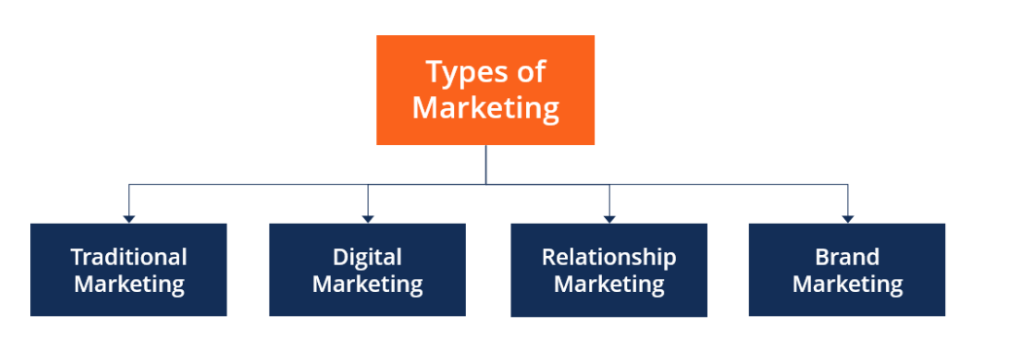
A firm’s chosen form of promotion hinges upon how its intended audience allocates their leisure activities. Here is an overview of contemporary key forms of advertising:
1. Traditional Marketing
Through conventional methods of promotion, what’s being referred to as “offline” advertising pertains exclusively to outreach directed at those lacking internet access. Some examples of classic promotional channels involve newspapers, yellow pages listings, and sending out address books. In various media outlets such as telephone listings, radio ads, or TV commercials, there is an inherent fee associated with each instance based upon both its magnitude and the method used for distribution aimed at reaching specific audiences. Even though modern methods have replaced many aspects of traditional marketing, these techniques continue to play an important role for companies aiming to reach specific markets.
2. Digital Marketing:
The digital realm stands in stark contrast to conventional methods when it comes to advertising strategies. This method leverages the internet for reaching its intended audience. Digital marketing encompasses several key areas such as search engine optimization, content creation for websites, promotion through social media platforms, direct email campaigns targeting consumers, pay-per-click advertising strategies, and enhancing visibility on search engines.
In recent times, the use of digital marketing techniques has become increasingly prevalent as technological advancements facilitate consumer access to both searching for and purchasing goods through electronic means. The cost seems lower than conventional methods since businesses don’t require external advertising through newspapers or TV channels anymore.
The digital realm offers an advantage in competition by allowing marketers direct influence on both content (“what”) and presentation methods (“how”), tailored specifically for reaching consumers effectively. Additionally, these individuals can obtain immediate feedback on their advertisements.
3. Relationship Marketing
A customer-centric approach aims at strengthening current connections for fostering lasting client satisfaction. Enhancing these connections aims at fostering a deep emotional bond between consumers via their interactions. Without dedicating resources to current customers, customer relations will falter; consequently, these same customers might seek out brands offering superior services instead.
Effective relationship management significantly benefits businesses by helping them maintain customer loyalty. Additionally, it enables them to focus more on developing products tailored to meet consumer demands they begin expressing. They possess tech enabling personalized promotions for devoted clientele.
4. Brand Marketing:
The practice of using branding techniques aims at making customers familiar with the company’s offerings so distinctly that it distinguishes them from competitors’ brands. A strategy entails leveraging humor and ingenuity to engage the audience through appealing visuals and narratives designed to evoke specific emotional responses related to the company’s branding elements for favorable perception of its products or services.
Brand marketing’s goal is to generate discourse about a particular topic in such a way that elevates the brand’s identity independently from the conversation. To illustrate, an example is provided where the prominent identity of Apple Inc. in the tech sector may be linked to its strategic placement of the brand’s reputation there. The designation of the firm correlates with its goods’ caliber. The focus on creativity boosts the success rate of product branding.
Conclusion: Why Marketing Matters for Every Business
Effective marketing plays a crucial role in attaining significant achievements and expansion within corporate operations. Beyond mere sales activities, it encompasses comprehending customer requirements and establishing fruitful commercial connections. By employing effective marketing strategies including product offerings, pricing tactics, distribution channels, and promotional activities, companies can effectively reach out to their intended customers and maintain market competitiveness. Given the rapid pace of technological advancement and expansion worldwide, employing effective marketing strategies proves advantageous for businesses.